In today's fast-paced digital marketplace, where attention spans are measured in milliseconds and product catalogs stretch into the thousands, crafting compelling descriptions that truly resonate with customers is more critical than ever. It's a task that demands creativity, consistency, and scalability – qualities often at odds with traditional manual copywriting. This is precisely why many businesses are now Choosing the Best AI Product Description Generator to supercharge their eCommerce efforts. These intelligent tools are no longer a futuristic fantasy; they're powerful allies, transforming raw product data into captivating narratives that drive sales.
But how do you navigate this burgeoning landscape of AI solutions? Which one will truly amplify your brand's voice and not just generate generic text? This guide will arm you with the insights and actionable strategies you need to make an informed decision, ensuring your chosen AI generator is a valuable asset, not just another subscription.
At a Glance: Key Takeaways for Choosing Your AI Product Description Generator
- Understand the "Why": AI generators offer speed, consistency, SEO benefits, and multilingual support, but they're not magic wands.
- Acknowledge Limitations: They may lack human nuance, struggle with ambiguity, and require careful prompting to avoid generic output.
- Prioritize Integration: Ensure your chosen tool plays nicely with your existing eCommerce platforms like Shopify, WooCommerce, or Amazon.
- Seek Customization: Look for robust options to tailor tone, voice, and language to your specific brand and global audiences.
- Master the Prompt: The quality of your AI output directly correlates with the quality of your input and prompting strategies.
- Always Review & Edit: AI is a powerful co-pilot, not a fully autonomous pilot. Human oversight is crucial for accuracy and brand alignment.
- Consider SEO: Tools that inherently optimize for keywords and search visibility offer a significant competitive advantage.
- Balance Cost & Features: Free tiers are great for testing, but paid plans often unlock essential bulk generation and advanced features.
Understanding the Power and Pitfalls of AI-Generated Descriptions
Before diving into the specifics of selection, let's establish a foundational understanding of what AI product description generators are and what they bring to the table. Simply put, these are AI-powered tools that take basic product information – features, specifications, unique selling points, even color and size – and convert it into engaging, market-ready descriptions. They analyze your input, understand the context, and generate text designed to inform and persuade.
The Unmistakable Benefits: Why AI is a Game-Changer
The appeal of these tools is multifaceted, addressing common pain points for eCommerce businesses of all sizes:
- Unparalleled Efficiency and Speed: Imagine generating hundreds of unique product descriptions in the time it would take a human copywriter to craft a handful. AI tools dramatically accelerate content creation, freeing up valuable human resources for more strategic tasks.
- Accuracy and Reduced Human Error: Manual copywriting is prone to typos, grammatical errors, and inconsistent messaging. AI minimizes these mistakes, ensuring a higher standard of accuracy across your product catalog.
- Brand Voice Consistency: Maintaining a uniform brand voice across thousands of products can be a Herculean task. AI generators, once properly trained or configured, can adhere to your brand's specific tone, ensuring every description sounds cohesive.
- Targeted Communication: By understanding your prompts, AI can help craft descriptions that resonate with specific audience segments, highlighting benefits that matter most to them.
- SEO and Discoverability: Many AI tools are designed with search engine optimization in mind, seamlessly incorporating relevant keywords to improve product visibility and conversion rates. This means your products are more likely to be found by the right customers.
- Multilingual Capabilities and Clarity: For businesses with international ambitions, AI generators can swiftly produce descriptions in multiple languages, facilitating global expansion. Moreover, their ability to create clear, structured content can also improve web accessibility for people with cognitive disabilities by simplifying complex information.
In essence, these tools don't replace human creativity; they amplify it, enabling businesses to tell more compelling stories faster and at scale.
Acknowledging the Limitations: Where AI Needs a Human Touch
While powerful, AI product description generators aren't infallible. Understanding their limitations is key to using them effectively and avoiding common pitfalls:
- The Creativity Ceiling: AI can be incredibly articulate, but it may struggle to replicate the nuanced emotional connection, genuine empathy, or unique "spark" of human storytelling. The truly iconic, deeply moving descriptions often require human intuition.
- Contextual Blind Spots: AI works best with clear, detailed input. For highly technical, niche, or abstract products, the AI might miss crucial nuances, requiring significant human refinement.
- Potential for Generic Content: Without careful prompting and iterative refinement, AI-generated descriptions can sometimes feel templated or generic. They are often best used as a sophisticated starting point rather than a final product.
- Inability to Handle Ambiguity: Vague or incomplete product details can lead the AI to generate incorrect information or simply fail to produce useful output. Precision in your input is paramount.
- Limited Understanding of Trends or Tone: AI doesn't inherently pick up on subtle cultural nuances, emerging market trends, or shifts in a brand's desired tone unless explicitly guided through prompts or training.
- Risk of Repetition: Over-reliance on an AI tool without varied prompts or human editing can lead to descriptions that recycle common phrases or patterns, potentially sounding repetitive across your catalog.
The takeaway? AI is a phenomenal co-pilot, but a human editor remains the indispensable captain, guiding the output and ensuring it truly reflects the brand's vision and voice.
How to Choose the Right AI Product Description Generator for Your Business
Selecting the ideal AI tool isn't a one-size-fits-all decision. It requires a thoughtful evaluation of your specific needs, budget, and existing tech stack. Here are the critical factors to consider when generating product descriptions with AI:
1. Compatibility and Seamless Integration
Your AI generator shouldn't exist in a silo. It needs to play nicely with your current ecosystem.
- Platform Support: Does it offer direct integrations or easy export options for your eCommerce platforms (Shopify, WooCommerce, Amazon, BigCommerce, Magento, etc.)? Seamless operation means less manual data transfer and a more efficient workflow.
- API Access: For larger operations or custom setups, an API (Application Programming Interface) allows for deep integration and automation, pushing generated descriptions directly into your product database.
2. Tone and Voice Customization
Your brand has a unique personality. Your product descriptions should too.
- Multiple Writing Styles: Look for tools that offer a range of styles – casual, formal, professional, witty, luxurious, informative – allowing you to match the tone to your brand identity and the product's nature.
- Brand Voice Training: Advanced tools might allow you to "train" the AI on your existing content or provide examples to help it adopt and maintain your specific brand voice over time.
- Target Audience Adaptation: The ability to specify a target audience (e.g., "young professionals," "eco-conscious parents") can help the AI tailor its language and focus on relevant benefits.
3. Language and Global Reach
If your business operates internationally, multilingual capabilities are non-negotiable.
- Extensive Language Support: Prioritize generators that offer robust support for multiple languages beyond just English.
- Cultural Nuance: While challenging for AI, some tools are better at generating culturally appropriate phrasing, moving beyond mere literal translation.
- Clarity for All: Consider how the tool's output contributes to web accessibility, ensuring clear and understandable descriptions for a diverse global audience, including those with cognitive disabilities.
4. Pricing Strategy and Value
AI tools come with various pricing models. It's crucial to understand the true cost.
- Flexible Plans: Look for tiered pricing that scales with your usage, from free trials/basic tiers for small businesses to enterprise solutions for large-scale operations.
- Bulk Generation Value: If you have a large product catalog, evaluate the cost-effectiveness of bulk generation features. Does it charge per word, per description, or offer unlimited generation within a tier?
- Hidden Costs: Be aware of potential limits on character count, revisions, or access to advanced features on lower-tier plans.
5. SEO and Marketing Optimization
Product descriptions aren't just for informing; they're for attracting customers through search engines.
- Keyword Integration: The best tools allow you to input target keywords and seamlessly weave them into the description naturally, not just stuff them in.
- Readability Metrics: Some generators offer built-in readability scores or suggestions to ensure your content is easy for both humans and search engines to digest.
- A/B Testing Support: While not a direct AI feature, look for tools that make it easy to generate variations for A/B testing, helping you optimize for conversion.
6. Creativity and Fine-Tuning Possibilities
To avoid generic output, your chosen AI needs to offer levers for creativity.
- Generation Variants: Does it offer multiple output options for a single prompt, allowing you to pick the best one or mix and match?
- Adjustable Creativity Levels: Some tools allow you to dial up or down the "creativity" or "randomness" of the output, giving you more control over the descriptive flair.
- Iterative Refinement: Can you easily edit, refine, or prompt the AI further based on its initial output to get closer to your ideal description?
7. Originality and Plagiarism Detection
In a world drowning in content, originality is paramount.
- Unique Content Generation: While AI generally generates unique text, the risk of repetition or unintentional similarity increases with generic prompts.
- Built-in Plagiarism Checks: Opt for tools that include or integrate with plagiarism detection to ensure your content is truly original and avoids potential copyright issues.
8. User Experience and Ease of Use
A powerful tool is only useful if you can actually use it efficiently.
- Intuitive Interface: Seek out a clean, straightforward interface with minimal learning curves. You shouldn't need a degree in AI to operate it.
- Quick Generation: How fast does it produce results? Delays can impede your workflow, especially during bulk generation.
- Guided Workflows: Tools that offer templates, guided questions, or step-by-step processes can significantly streamline the description writing process.
9. Versatility Across Industries and Product Types
Your product range might be diverse, so your AI should be too.
- Adaptability: Can the generator handle various product types, from electronics and fashion to services and highly technical goods?
- Niche-Specific Templates: Some tools offer specialized templates for different industries, which can be a huge time-saver and improve relevance.
Mastering the AI: Strategies to Write the Best eCommerce Content
Even the most advanced AI is only as good as the input it receives. Think of prompting as an art form that transforms generic AI into a highly specialized content creator. Here are five strategies to guide your AI to generate truly compelling product descriptions:
1. Highlight Features That Matter (and Their Benefits!)
Don't just list specifications; tell a story about how the product improves a customer's life. Guide the AI to focus on tangible benefits.
Example Prompt: "Create a product description for a wireless noise-canceling headphone that emphasizes comfort, battery life, and sound quality for remote workers and travelers. Focus on how these features enhance productivity and relaxation on the go."
2. Create Emotional Connections
Help customers envision themselves using and benefiting from the product. Craft narratives that tap into desires, aspirations, or solutions to everyday frustrations.
Example Prompt: "Write a story-driven product description for a smart water bottle. Emphasize how its hydration tracking and gentle reminders help busy professionals stay energized and focused throughout their hectic day, turning a mundane habit into a vibrant wellness ritual. Use an engaging and relatable tone."
3. Address Customer Pain Points
Identify common frustrations your target audience experiences and position your product as the ultimate solution. This shows empathy and directly addresses customer needs.
Example Prompt: "Write a product description for a premium lumbar support cushion that directly addresses common back pain and discomfort experienced by office workers and remote professionals who spend long hours at a desk. Highlight its ergonomic design and long-term health benefits."
4. Get Playful and Creative
Inject personality, humor, vivid metaphors, or unique angles into your descriptions. Don't be afraid to experiment with diverse tones to make your products stand out.
Example Prompt: "Write a product description for a smart home security camera using a humorous, slightly quirky tone. Frame it as your home's vigilant (and slightly overprotective) best friend, guaranteeing peace of mind with a wink."
5. Optimize for Search Engines (Naturally)
Seamlessly weave in high-ranking keywords so they sound natural and part of the narrative, not forced. Guide the AI to integrate them contextually.
Example Prompt: "Write a product description for an eco-friendly bamboo toothbrush, naturally incorporating the keywords: 'sustainable toothbrush,' 'eco-friendly oral care,' and 'plastic-free alternative.' Emphasize its positive environmental impact and superior cleaning, using a conversational and relatable tone."
Crafting Attractive Product Descriptions with AI: A Step-by-Step Guide
Once you've chosen your AI tool and developed your prompting strategies, follow these steps to turn AI-generated drafts into polished, high-converting product descriptions:
- Choose Your Tone and Stick With It: Before you even prompt the AI, define the desired tone for your description. Is it luxurious, practical, playful, scientific, or empathetic? Align this selected tone with your brand identity and the product's nature, then explicitly instruct the AI. Consistency builds trust.
- Make Minor Edits and Personalize: AI-generated content is a fantastic first draft, but it's rarely perfect. Review it carefully.
- Fact-Check: Ensure all product specifications and claims are 100% accurate. AI can hallucinate.
- Brand Voice Alignment: Tweak phrasing to perfectly match your brand's unique voice and personality.
- Flow and Readability: Adjust sentence structure, word choice, and paragraph breaks for optimal flow and readability.
- Call to Action: Ensure a clear and compelling call to action is present, if appropriate.
- Set a Character Limit (and Adhere to It): Different eCommerce platforms (Amazon, Shopify, Etsy, your own website) often have recommended or strict character limits for product descriptions. Set a clear character or word count target for the AI, and then edit the output to ensure it adheres to these limits for optimal readability and platform compliance. A typical good description might be 100-500 words, but always adjust based on product complexity and platform requirements.
- Focus on Benefits, Not Just Features: This is a crucial editing step. While features are important, customers buy benefits. Emphasize how the product solves a problem, fulfills a need, or improves their life. Transform "It has X feature" into "This X feature allows you to [benefit Y]." This highlights the true value to the customer.
Recommended AI Product Description Generators: A Closer Look
The market is awash with AI writing tools, but some stand out for their product description capabilities. Here's a deeper dive into some top contenders, helping you compare based on features, target users, and known limitations.
1. YesChat.ai
- Best For: Medium to large eCommerce businesses seeking high versatility and cutting-edge AI models.
- Strengths: Leverages advanced models like GPT-4o and Claude 3.5. Offers extensive multilingual support and boasts a high token input limit (up to 200,000 words), making it suitable for comprehensive product data. Includes commercial image and music licensing features, hinting at broader content creation capabilities.
- Limitations: Its power can lead to a complex interface with overwhelming options, requiring precise prompt engineering to achieve desired results. May have a steeper learning curve than simpler tools.
- Pricing: Not explicitly stated, but typically subscription-based for advanced features.
2. Ahrefs AI Product Description Generator
- Best For: Budget-conscious businesses and SEO-focused brands.
- Strengths: Known for its strong SEO capabilities, helping to decode search algorithms and optimize content. Offers image-based generation, customizable tones, multiple languages, and flexible description lengths. Its core offering for product descriptions is free.
- Limitations: The 10MB upload limit for images can be restrictive for high-resolution assets. Descriptions can feel generic without very detailed input, as its primary focus remains text-based SEO rather than creative storytelling.
- Pricing: Free for the AI product description generator.
3. VModel.ai
- Best For: Fashion retailers and visual product marketplaces where aesthetics are key.
- Strengths: Unique in its ability to generate descriptions directly from images using ChatGPT Vision. It analyzes visuals to create accurate and emotionally resonant descriptions. Features a specialized clothing generator and instantly optimizes content for SEO.
- Limitations: Requires high-quality images to function effectively; blurry or complex visuals may confuse the AI. Customization for text output can be limited, as it prioritizes visual interpretation.
- Pricing: Likely subscription-based; specific tiers would need checking.
4. Copy.ai
- Best For: Small to medium eCommerce businesses needing rapid content solutions across various marketing needs.
- Strengths: Known for instant content creation with minimal input. Generates multiple variants for testing, integrates SEO with keyword functionality, and supports bulk processing. Offers support for over 25 languages.
- Limitations: While fast, it often requires specific and detailed input to avoid generic output. May lack technical nuance for highly specialized products and can occasionally "hallucinate" details, necessitating careful human review.
- Pricing: Free base tier available, with professional versions offering more features and higher usage limits.
5. Frase
- Best For: Content creators and marketers seeking research-driven descriptions and comprehensive content strategies.
- Strengths: An advanced generator that synthesizes web information, performing automated research across 20+ search results. Offers adaptive creativity levels (from 1 to 5) and multi-source integration for robust content.
- Limitations: Its comprehensive nature can be complex for new users. There's a risk of over-relying on existing online content if not guided properly, potentially limiting true originality.
- Pricing: Solo $14.99/month, Basic $44.99/month, Team $114.99/month (as of ground truth).
6. ClickUp AI
- Best For: Teams looking for integrated workflow solutions and comprehensive content/project management within a broader platform.
- Strengths: Part of a larger project management suite, it generates not just product descriptions but also marketing strategies, taglines, product names, and can transform content or summarize tech specs with one click. Offers integrated copy editing.
- Limitations: Advanced AI features are typically limited to paid plans. The extensive feature set of ClickUp itself can lead to a learning curve for new users.
- Pricing: AI features are usually part of higher-tier subscriptions.
7. CopySmith
- Best For: Medium to large eCommerce businesses and multi-platform online retailers focused on direct integrations.
- Strengths: Specifically tailored for eCommerce, offering direct integrations with platforms like BigCommerce, Shopify, and Amazon. Facilitates bulk content generation and product catalog management, streamlining publishing workflows.
- Limitations: May offer limited customization options for highly complex or unique products. Costs can become significant for very large-scale content generation needs.
- Pricing: Starter $19/month, Pro $49/month, Enterprise (contact for custom pricing) (as of ground truth).
8. Jasper
- Best For: Brands with specific communication guidelines and those requiring multilingual and diverse content with a consistent voice.
- Strengths: Renowned for adaptive AI generation, maintaining consistent brand voice, and offering multiple writing styles and tone selections. Includes a browser extension and automatic translation capabilities. Allows for customizable AI training.
- Limitations: Achieving optimal results often requires complex AI prompting and iteration. Users might encounter repetitions or inconsistencies if prompts aren't refined over time.
- Pricing: Creator $49/month, Pro $69/month, Business (contact for custom pricing) (as of ground truth).
9. LogicBalls
- Best For: eBay sellers on a budget.
- Strengths: Specifically designed for eBay, claiming to outperform ChatGPT for eBay descriptions at a lower price point. It analyzes high-performing eBay listings for insights, supports multiple languages and a wide range of tones, and offers rapid generation.
- Limitations: The diversity of tones, while good in theory, might sometimes feel redundant or overly broad for the very specific needs of product descriptions. Its strength is primarily focused on eBay.
- Pricing: Free tier available, premium $9.99/month or $59.99/year (as of ground truth).
10. B12
- Best For: Small to medium businesses and entrepreneurs providing professional services who need a comprehensive website solution.
- Strengths: Offers an intuitive workflow for product and service descriptions, integrated within an AI-powered website builder. Provides instant content, multiple tone/use-case options, and integrates with 26 other services.
- Limitations: While versatile, customization for highly specialized content may suffer from over-reliance on its general-purpose AI. Less suitable for complex, physical product catalogs compared to dedicated eCommerce tools.
- Pricing: Basic $42/month, Professional $169/month, Advanced $339/month (as of ground truth).
11. HIX.AI
- Best For: Writers and marketers seeking a comprehensive AI writing toolkit with strong customization.
- Strengths: A versatile toolbox featuring an editor-like system, options for target audience definition, choice of GPT versions, talking points generation, and robust tone of voice selection.
- Limitations: As a broader content tool, its specific product description capabilities might require more manual guidance compared to niche-focused generators.
- Pricing: AI Writer Basic $7.99/month, Pro $11.99/month, Unlimited $39.99/month (as of ground truth).
12. Narrato
- Best For: Content marketing teams needing an integrated workspace for content creation and publishing.
- Strengths: Functions as a full content marketing workspace with an editor-like system, extensive customization options for target length and format. Offers publishing opportunities directly to CMS.
- Limitations: Its strength lies in being a complete workspace, meaning dedicated product description features might be part of a larger, more complex system.
- Pricing: Pro $36/month, Business $76/month, Custom (contact) (as of ground truth).
13. Simplified
- Best For: Marketers and small businesses looking for an all-in-one platform with free AI description capabilities.
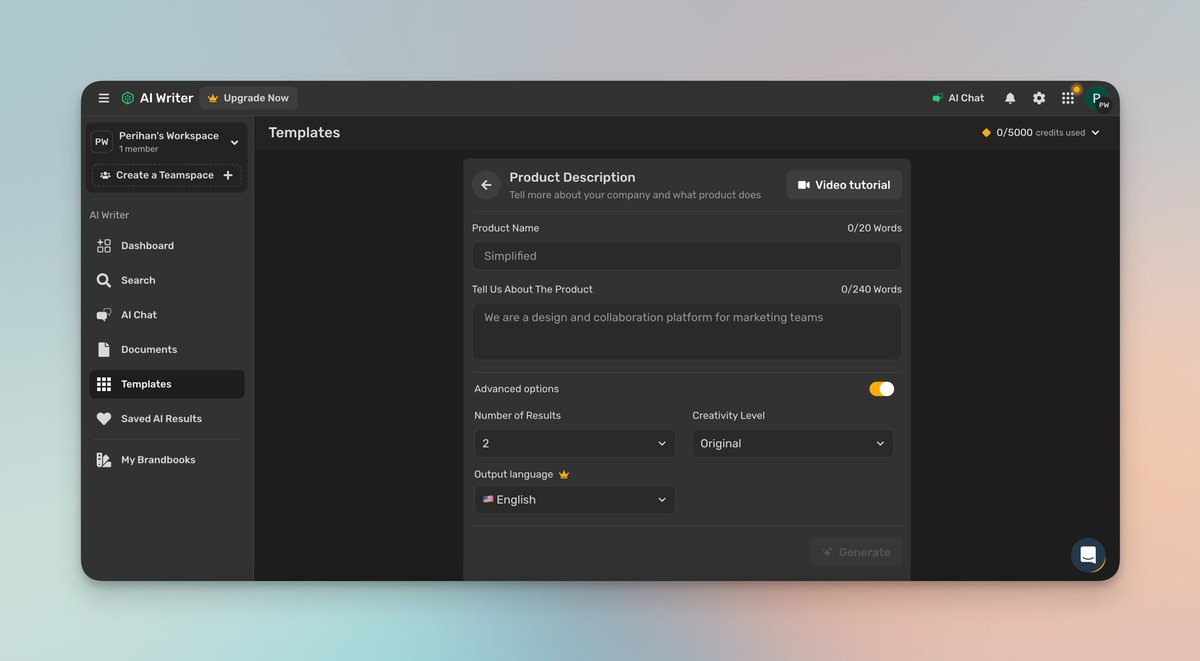
- Strengths: A comprehensive software for marketers, offering a free AI Product Description Copy Generator with templates, customizable fields, creativity level selection, output language, and multiple result options.
- Limitations: The "free" aspect often implies limitations on usage or access to advanced features compared to paid tiers.
- Pricing: Pro $18/month, Business $29/month, Agency $119/month (as of ground truth).
14. Magiscriptor
- Best For: eBay and Amazon sellers prioritizing high-converting descriptions with optimal keyword density.
- Strengths: Favored among marketplace sellers. It takes keywords as input and generates descriptive paragraphs, focusing specifically on creating high-converting descriptions with strategic keyword density.
- Limitations: Its specific focus on marketplaces means it might be less versatile for other eCommerce platforms or highly branded website descriptions.
- Pricing: Credit-based: Starter $4.99 (100 credits), Basic $9.99 (220 credits), Silver $14.99 (330 credits), Gold $19.99 (450 credits) (as of ground truth).
15. AISEO
- Best For: Writers, SEO specialists, and marketers focused on creating SEO-optimized content efficiently.
- Strengths: An AI productivity tool with an advanced description generator. Uses guided questions to help users formulate prompts, offers robust tone and language customization, and excels at keyword integration.
- Limitations: Like other SEO-focused tools, the creative flair might need more direct guidance compared to tools emphasizing narrative generation.
- Pricing: Grow $24/month, Scale $44/month, Team $129/month (as of ground truth).
16. Hypotenuse AI
- Best For: Businesses requiring comprehensive content creation software with a structured approach to descriptions.
- Strengths: Offers step-by-step product description generation, bulk generation, helpful tooltips, and supports brand name and keywords for SEO.
- Limitations: The structured approach might feel less flexible for users who prefer a completely free-form prompting style.
- Pricing: Individual $29/month, Team $59/month, Enterprise (contact) (as of ground truth).
17. Writesonic
- Best For: Versatile content creation across many writing tasks, with tailored solutions for eCommerce.
- Strengths: A versatile AI tool known for producing high-quality content with minimal edits. Offers tailored solutions for eCommerce product descriptions and allows for keyword list integration.
- Limitations: While versatile, achieving the absolute best, most unique product descriptions often still requires careful initial setup and refinement compared to highly specialized tools.
- Pricing: Free trial available, Pro $12.67/month (100,000 words), Enterprise (contact) (as of ground truth).
Frequently Asked Questions About AI Product Description Generators
Clear answers to common questions can provide quick clarity and help you navigate the AI landscape with confidence.
What is "Commerce Content"?
Commerce content refers to any written material describing products, their features, benefits, and compelling reasons for a purchase. This includes product descriptions, category pages, buying guides, and more – all aimed at driving sales.
How do I start creating eCommerce content using AI?
Begin by thoroughly understanding your product and your target audience. Use an AI generator to create initial drafts focusing on clear, concise descriptions that highlight unique features and benefits. Then, always review, refine, and personalize the AI's output to align with your brand voice and ensure accuracy.
What is an "App Description Generator"?
An app description generator is a specialized AI tool designed to create compelling descriptions specifically for mobile applications. It helps developers communicate an app's features, benefits, unique selling points (USPs), and target audience in a way that encourages downloads on app stores.
Are there any free product description generators?
Yes, several tools offer free tiers or completely free generators. Ahrefs provides a robust free SEO-focused generator, and Copy.ai, Simplified, and LogicBalls (with a free tier) are other popular options to explore. These free versions often come with usage limitations.
How accurate are AI-generated product descriptions?
The accuracy of AI-generated descriptions is best when you provide clear, detailed, and comprehensive input. However, AI can sometimes "hallucinate" or misinterpret information. It's imperative to always review, fact-check, and edit the generated content for factual accuracy, grammatical correctness, and brand voice alignment before publishing.
What is the ideal length for a good product description?
The ideal length typically ranges from 100 to 500 words, but this is highly adjustable based on the product's complexity, the platform you're using (e.g., Amazon often prefers longer, detailed descriptions; social media might require shorter, punchier ones), and your target audience. Focus on conveying value concisely.
Do I need special expertise to use these tools?
No, most AI product description generators are designed with user-friendliness in mind, requiring no special technical or AI expertise. Their intuitive interfaces and guided workflows make them accessible to business owners, marketers, and copywriters alike. The "expertise" you'll develop is in crafting effective prompts.
Can AI product descriptions enhance the user experience?
Absolutely. By rapidly generating engaging, transparent, and accurate product information, AI tools help ensure customers have all the details they need to make informed purchasing decisions. This clarity and consistency can significantly enhance the overall user experience and build trust.
Your Next Step: Experiment, Refine, and Scale
The journey to finding the "best" AI product description generator is less about identifying a single, universal solution and more about discovering the tool that perfectly fits your unique business context. Start by identifying your core needs: Are you prioritizing SEO? Multilingual support? Speed for a vast catalog? Or deep integration with your existing platforms?
Take advantage of free trials and free tiers to test a few promising options. Experiment with different prompting strategies. Observe how each tool responds to your specific product data and brand voice requirements. Remember, AI is a powerful assistant, but the strategic direction and final polish remain firmly in your hands. Embrace the efficiency, leverage the capabilities, and free up your creative energy to build even stronger connections with your customers. The future of eCommerce content is here, and it's remarkably collaborative.